4.50
(12 Ratings)

3 — The power of inclusive language in sports environments

Uncategorized

About Course

Strategies and tools to use inclusive language, foster respect, and empower women in sports environments.

Description and overall objective

This course focuses on the importance of inclusive language in sports environments to promote gender equality, respect and empowerment. It covers soft skills for coaches, definitions and examples of inclusive language, its impact on the development of both coaches and athletes, and strategies for promoting inclusive communication in sport settings.

By attending this course, you will gain the knowledge and skills to use inclusive language in sports environments, recognize and challenge exclusionary language and behaviors, foster respect and empowerment, and enhance communication among athletes and coaches. You’ll also learn strategies to create a more inclusive and supportive atmosphere in sports settings.

Learning outcomes

On completion of this course, you will be able to:

  1. Develop and apply soft skills to create inclusive and respectful environments in sports.
  2. Appreciate and use inclusive and non-sexist language, identifying and avoiding discriminatory communication.
  3. Recognise how inclusive language builds and strengthens athletes’ self-esteem, self-efficacy and leadership skills.
  4. Implement strategies and tools to promote inclusive language in sports communication and media.
  5. Apply best practice through role play and exercises to improve inclusive communication skills for coaches, educators, officials and managers.

Course Content

Unit 3.1 Soft skills for trainers and coaches to promote inclusivity
This unit covers the importance of soft skills, including empathy, effective communication, and leadership, in fostering inclusive sports environments. It also explores specific techniques for developing these skills and their practical applications in the everyday work of coaches.

  • Overview
  • Quote
  • Introduction
  • Quizlet Flashcards
  • Empathy
  • Inclusive Communication in Action – Scenario Activity
  • Effective Communication
  • Quiz
  • Inclusive Leadership
  • Interactive Activity: Drag-and-Drop Pre-Set Options
  • Cultural Intelligence
  • Quiz – Cultural Awareness
  • Conflict Resolution
    03:51
  • Building Positive Relationships
  • Quiz – Video
    01:53

Unit 3.2 Understanding and applying inclusive and non-sexist language in sport
This unit defines “inclusive language” and “non-sexist language” while providing practical examples and real-life scenarios in sports where these concepts are applied. Additionally, it explores methods for identifying and eliminating discriminatory language to promote a more equitable and respectful environment, with a focus on supporting female basketball coaches and athletes.

Unit 3.3 The role of inclusive language in empowering female athletes and coaches
This unit examines how inclusive language positively impacts the psychological well-being of coaches and athletes, particularly in areas such as self-esteem, self-efficacy, and leadership development. Through case studies and real-life stories, it highlights how positive and inclusive language practices contribute to women’s empowerment and personal growth in sports.

Unit 3.4 Strategies, tools and techniques for inclusive language in sports communication and media
This section offers practical guidance on using inclusive language across various sports communication channels, including interviews, reporting, and social media. It introduces tools and techniques to promote respectful and inclusive language in both formal and informal settings, helping create more balanced and fair narratives for women in sports.

Unit 3.5 Self-reflection, role-play scenarios and exercises
This final unit presents interactive activities, such as role-playing scenarios, designed to encourage self-reflection and enhance participants’ inclusive communication skills. Through these exercises, coaching education providers, coaches, officials, and administrators will develop the skills needed to effectively apply inclusive language in their professional roles, thus fostering a more respectful and equitable sports environment.

Assessment Quiz

Earn a certificate of completion

Add this certificate to your resume to demonstrate your skills & increase your chances of getting noticed.
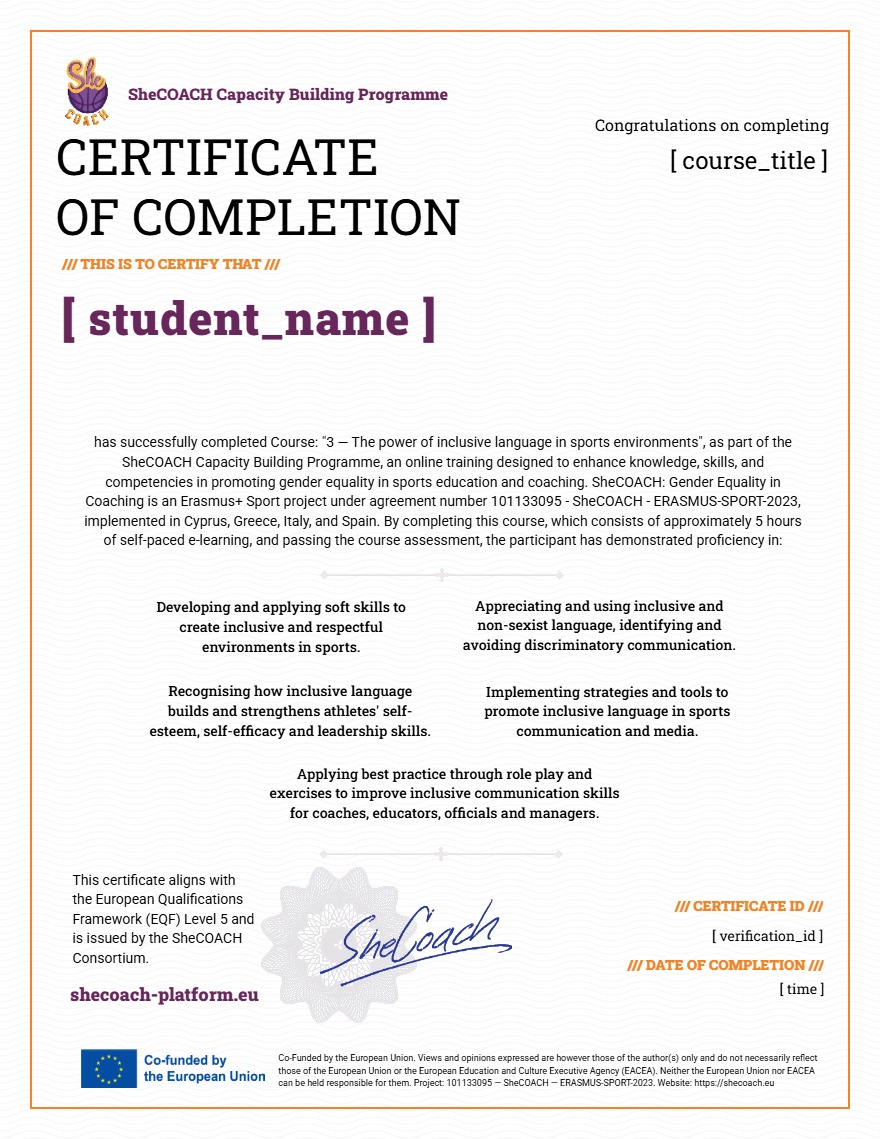
selected template

Student Ratings & Reviews

4.5
Total 12 Ratings
5
8 Ratings
4
2 Ratings
3
2 Ratings
2
0 Rating
1
0 Rating
BM
11 months ago
Very good experience, I have learned about the importance of inclusive language
It is very interesting to realize that small actions and phrases in a team's dialogue can motivate and stimulate the team to a greater extent.
SA
11 months ago
Maybe a bit more activities to engage better the content of boxes to write in time reflection activities could be better.
MV
11 months ago
Very interesting tematic
Useful words, sentences and ideas to promote equality in general.
MD
11 months ago
Great contents and structure!
FP
11 months ago
Κοιτάμε το δέντρο και χάνουμε το δάσος. Τι σχέση έχει η γραμματική και τα φύλα που χρησιμοποιούμε (αρσενικό /θηλυκό/ουδέτερο), με τις διακρίσεις που υφίσταται η γυναίκα στον αθλητισμό; Με άλλο τρόπο πρέπει να αλλάξει αυτό (σταματώντας τις προσβολές και τις βρισιές προς τη γυναίκα και προβάλλοντας περισσότερο τα γυναικεία αθλήματα). Το να πω στην ομάδα που αποτελείται από κορίτσια, "Μπράβο κορίτσια" , πως το θεωρείτε λάθος; Πιο προσβλητικό είναι να πω "Μπράβο σε όλους" από τη στιγμή που η ομάδα αποτελείται από κορίτσια. Εγώ προσωπικά σαν αθλήτρια, αν ο προπονητής μου μου έλεγε "Μπράβο σε όλους", θα ένιωθα ότι με πρόσβαλλε και ότι με υποτιμάει. Ο όρος "παιδιά", αναφέρεται και σε κορίτσια και σε αγόρια, συνεπώς δεν το θεωρώ υποτιμητικό /προσβλητικό/ σεξιστικό να αναφέρετε σε μια ομάδα μεικτή ή αμιγής. Έχουν περάσει 20 χρόνια από τότε που ο όρος αυτός αναφερόταν μόνο σε αγόρια. Πολλή θεωρία το μάθημα και μάλιστα ουτοπική. Γνωρίστε από κοντά ομάδα μπάσκετ και θα αντιληφθείτε πως αντιμετωπίζουν μια γυναίκα προπονήτρια, τις ευκαιρίες που τις δίνονται, την εμπιστοσύνη που της δείχνουν και την μη έλλειψη σεβασμού και κατανόησης στο γεγονός ότι η γυναίκα είναι εργαζόμενη, μητέρα, σύζυγος κλπ. Το πρόβλημα είναι αλλού και δεν λύνεται υιοθετώντας έναν "ξύλινο" λόγο.
JM
11 months ago
It was informative, well-structured, and provided practical insights into the importance of inclusive language in sports. The content was engaging, and the examples helped make complex concepts more relatable.
KG
11 months ago
It was a fantastic course. I have to review a lot of thinks. We need better communication and continuous training
EK
12 months ago
This course highlights the importance of inclusive language in fostering a supportive and welcoming sports environment. It effectively demonstrates how small changes in communication can create a more positive and respectful atmosphere for athletes of all backgrounds. The examples provided were insightful, and the strategies shared are practical and easy to implement. Highly recommended for coaches, athletes, and sports professionals looking to promote inclusivity in their teams and organizations.
Chris B
12 months ago
Great interactive activities :)
PE
12 months ago
Good but there are some mistakes in cultural intelligence quiz (question 2 and 5)

Want to receive push notifications for all major on-site activities?